


How We Learn
How the teachers at Disraeli deliver the curriculum.
At Disraeli we have a research-based shared pedagogy - this means that HOW we teach the curriculum is planned and deliberate and understood by all. We call this our Disraeli Teaching For Learning Approach.
We are currently working together to refine our approach to ensure there is Quality First Teaching in all classrooms and to be able to skillfully adapt teaching to meet the needs of every learner.
The ‘how we teach at Disraeli' approach is constructed upon the foundations of Rosenshine’s Principles of Instruction, as adapted for schools, and Retrieval Practice, whilst focussing on the brain, neuroscience, memory and learning. We also ensure that Trauma Informed and Attachment Aware approaches are embedded in to curriculum delivery.
From the EEF (Education Endowment Fund)
- Self-regulated learners are aware of their strengths and weaknesses and can motivate themselves to engage in, and improve, their learning.
- Developing pupils’ metacognitive knowledge of how they learn—their knowledge of themselves as a learner, of strategies, and of tasks—is an effective way of improving pupil outcomes.
- Teachers should support pupils to plan, monitor, and evaluate their learning through explicitly teaching, modelling, and scaffolding the use of metacognitive strategies.
Ready to Learn - Interoception
When we are emotionally regulated, our brains are in the best state for learning. Strong emotions such as anxiety, frustration, anger, or overwhelm can trigger our brain's survival response, making it harder for the prefrontal cortex, the part of the brain responsible for thinking, reasoning, creating, problem-solving, and self-management, to do its job effectively. When this happens, children may struggle to focus, remember information, manage their behaviour, or engage in learning tasks, not because they are unwilling, but because their brains are working to cope with the emotional challenge first. This is why emotional regulation is so important in education: before meaningful learning can take place, children need to feel safe, supported, and regulated enough for their thinking brains to come back online.
This is a great video from the BBC to explain how our brains work when we feel big emotions...
https://www.bbc.co.uk/teach/class-clips-video/articles/zd7kd6f
We use the Zones of Regulation to give the children a visual framework and a set of vocabulary that they can use to understand and explain how they are feeling.
//www.youtube.com/embed/zZ9X-d3oZvQ#t=0.5
At Disraeli School, we use the Zones of Regulation from Nursery through to Year 6 because understanding and managing emotions is a vital life skill that supports both learning and relationships. The Zones provide a simple, consistent framework that helps children recognise how they are feeling, understand that all emotions are normal, and develop strategies to regulate themselves when needed. As children move through the school, the vocabulary and concepts are introduced in increasingly sophisticated ways, allowing them to deepen their understanding of emotions, self-awareness, and self-regulation over time. This shared language helps children communicate their feelings more effectively, build positive friendships, show empathy towards others, and navigate social situations with greater confidence. Academically, the Zones support children to identify when they are ready to learn and what they need to do to return to a regulated state if emotions begin to overwhelm them. By helping children develop these skills from an early age, we are equipping them with tools that not only support success in school but can also be used at home and throughout their lives to promote wellbeing, resilience, and independence.
You can find out more about Emotion Coaching here:
//www.youtube.com/embed/7KJa32r07xk#t=0.5
We teach the children the "hand model of the brain". This helps to understand what happens when our emotions take over and we can't think clearly and sensibly - we call this "flipping the lid!"
//www.youtube.com/embed/Kx7PCzg0CGE#t=0.5
We also know that often things happen in the life of a child that can affect the way the brain works for a very long time. You can find out more about Childhood Trauma and Brain Development here. Some people may find this distressing so please watch with caution.
//www.youtube.com/embed/xYBUY1kZpf8#t=0.5
Here are some ideas for using Regulation Strategies to help calm down when emotions feel too big...
//www.youtube.com/embed/Bd46PH9ChC0#t=0.5
Understanding our brains in these ways helps us to understand how we learn, and plan for all the children in our care.
Characteristics of Effective Learners...
......Meet Fred's Friends!
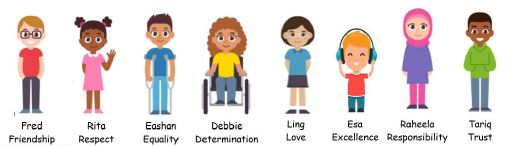
These are our school values personified! Our values guide us in our relationships and social interactions. However, they also help us to understand some of the skills we need to be effective learners.